Beyond Requirements
Redefining Business Analysis in the Age of AI
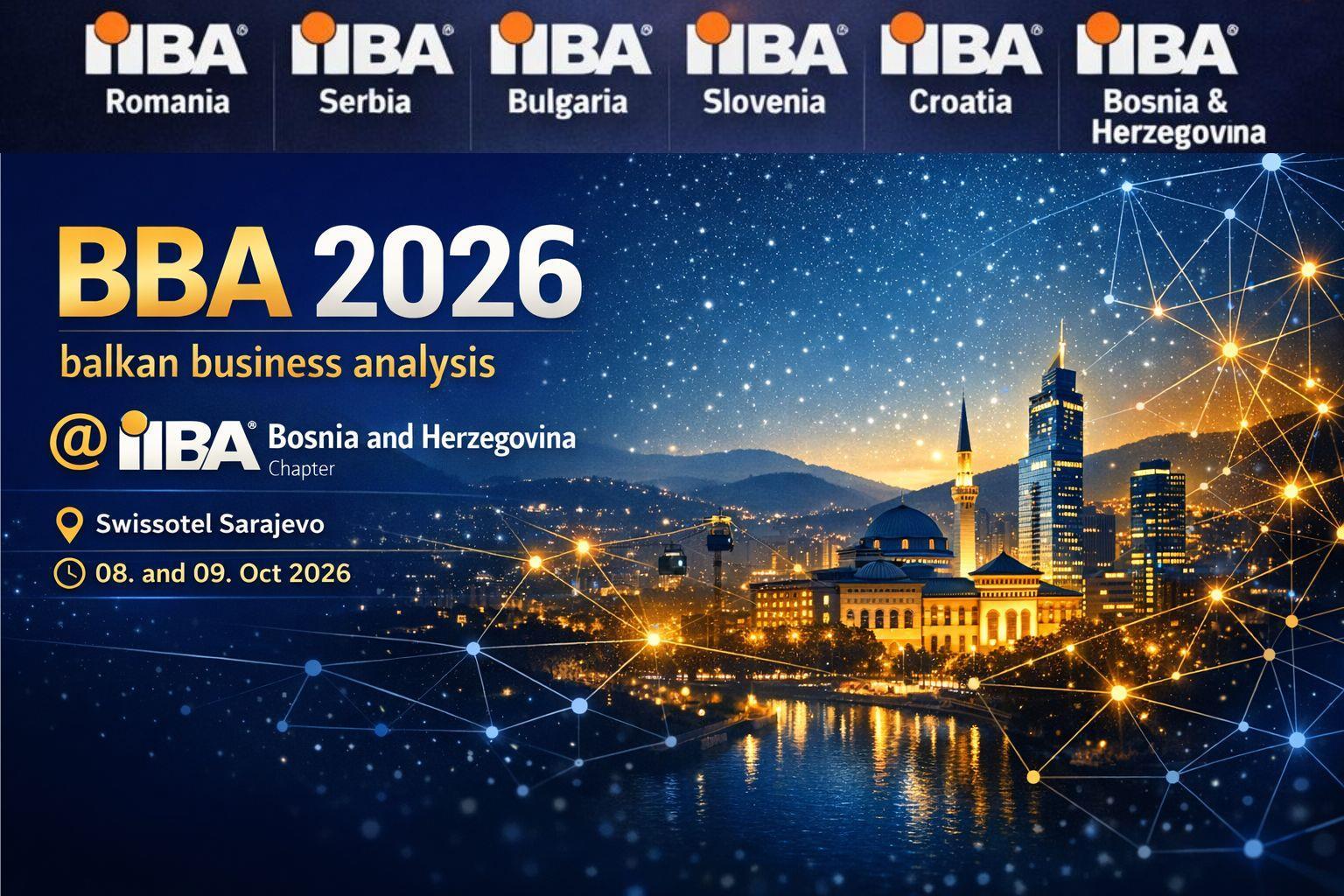
Balkan Business Analysis Conference is an annual event working towards our mission: Bring BA professionals from the Balkan region together to exchange knowledge, experience and opportunities.
The BBA Conference is co-organized by IIBA Chapters from Bulgaria, Slovenia, Serbia, Romania, Croatia and Bosnia Herzegovina.
The goal of the IIBA Balkan Conference 2026 is to strengthen the role of business analysis as a driver of change. By connecting professionals from public and private sectors, the conference aims to share practical knowledge, promote best practices, and inspire collaboration .
Thursday · 8 October 2026

08:00 - 09:00
Pre-Conference Check-In and Networking

09:00 - 09:10
Opening Ceremony – Welcome by IIBA Bosnia and Herzegovina Chapter

09:10 - 09:20
Sponsors’ Welcome and Acknowledgements

09:20 – 10:10
Keynote Speech: Fabricio Laguna
IIBA Senior Advisor
AKA THE BRAZILIAN BA
PROFESSIONAL SPEAKER, CONSULTANT AND TRAINER, CBAP, AAC, CPOA, PMP, MBA
Enabling Confidence In The Age of AI
How business analysis builds confidence to lead AI transformation

10:10– 10:40
Bindu Channaveerappa
Founder of CS-BA.com, Director IIBA UK - CS-BA.COM - UK
From Silos To Sinergy
A case study from Information Systems — the national system integrator of the Republic of Bulgaria

10:40– 11:00
☕ Coffee Break & Networking

11:00– 11:40
Panel Discussion: Future of Business Analysis Role in Spec Driven Development

- Bojana Hidić Senior Business Analyst at Endava, BiH

- Vedad Šehanović Erste Bank Austria . Austria

- Marijana Rončević Infobip, Croatia

11:45– 12:45
🍽️ Lunch Break
Parallel Sessions 12:45-13:15

⏱️ 12:45-13:15
Taras Zakharkiv
Head of Business Analysis Office · ELEKS · Ukraine
Upskilling Toward AI-Native BA Practice: Market Signals, Field Observations, and Your Skills Map
Focus AI-Driven Business Analysis and Intelligent Value Creation (Primary Focus Area)

⏱️ 12:45-13:15
Vedran Sajevic
When Stakeholders Tell Us More Than They Say
Looking Beyond Words to Better Understand Stakeholders

⏱️ 12:45-13:15
Cristina Gheorghiu
Delivery Manager · Endava · Romania
Touch the Value
X-ray value to reveal what success really looks like
Parallel Sessions 13:20-13:50

⏱️ 13:20-13:50
Software Test Manager · System Verification · Bosnia & Herzegovina
Breaking the Black Box: How Do We Test AI Systems and Ensure Business Value
Focus Testing AI systems: bridging quality assurance and business analysis for reliable, valuable solutions

⏱️ 13:20-13:50
Amina Sabic - Muharemovic
Lejla Kameric
From Hype to Impact: How to actually measure AI productivity in IT delivery

⏱️ 13:20-13:50
Ivana Radin
Senior Business Analyst · Endava · Serbia
Prompt Engineering is the New Requirements Engineering: A Core Skill for Modern Business Analysts
Focus AI-Driven Business Analysis and Intelligent Value Creation
Parallel Sessions 14:00-14:30

Can You Really Talk to Your Data? What Actually Works Today

How Business Analysts Can Turn Raw Data Into Executive Reports with AI

⏱️ 14:00-14:30
Natasha Kostikj Miloshevski
Endava · North Macedonia- Principal Business Analyst
Tanja Kekenovska
Senior Business Analyst · Endava · North Macedonia
Reframing AI Value: From Productivity Tool to Decision-Quality Amplifier
Focus AI for Decision Support and Predictive Insight
14:30– 14:50
☕ Coffee Break & Networking
Parallel Sessions 14:50- 15:20

⏱️ 14:50-15:20
Aleš Štempihar
vice president IIBA Slovenia Chapter, CEO Sparring Partner & Askit
Primož Frelih
IIBA Slovenia member, CEO Agital
Andrej Guštin
president IIBA Slovenia Chapter, Co-founder Process Space
AI-Driven Business Analysis and Intelligent Value Creation

Corporate Client Onboarding Prototype: Powered by ChatGPT & Lovable
Focus: AI-Driven Business Analysis and Intelligent Value Creation

⏱️ 14:50-15:20
Aleksandar Jovicic
Senior Business Analyst · Endava · Serbia
The Art of Training AI
Focus: Large Language Models & Human-in-the-Loop Training
Parallel Sessions 15:25- 15:55

⏱️ 15:25-15:55
From Ticket Writer to Leader: Delivering Impact Through Standardized Analysis
Branka Nesterović Haining
Martin Marečić

⏱️ 15:25-15:55
Certified or Capable? The Real Value of IIBA Certifications
Susan Moore

Andy Grazebrook
London, England, United Kingdom

- Dzenana Bricic Kerla, Senior Business Analyst at Comtrade, BiH

- Dzenana Dzaferovic, Senior Business Analyst, Erste Bank Austria

- Vedran Sajevic, Project Manager / Business Analyst, Sweden

⏱️ 15:25-15:55
Challenging, Questioning, Evaluating: Future-Proof Your BA Career in the Era of AI
Focus Leadership, Strategy, and the Future of the BA Profession
Denis Georgiev
Business Analyst · KPMG Delivery Network · Bulgaria
Parallel Sessions 16:00 - 16:30

⏱️ 16:00-16:30
Fuad Ćurčić
One Person, Four Roles? How AI Is Blurring the Software Lifecycle

⏱️ 16:00-16:30
Irena Cvetić
Engineering Lead / Lead Business Analyst · Q Agency · Croatia
From BA to Leader: Creating Value While Leading Across Roles and Teams
Focus Leadership and Soft Skills

Managing Consultant · PMBA Ltd. · Bulgaria
The Big Picture: A Business Architecture Toolkit for Business Analysts
Focus Practical Business Analysis Methods, Tools and Techniques; Adaptive BA Practices

16:30 – 17:00
Closing Remarks & Networking
Room: Zeneva 3
Friday · 9 October 2026
08:00 - 09:00
Welcome Coffee and Networking
09:00 – 09:10
Welcome

09:10– 10:00
Keynote Speech: Filip Hendrickx
Innovating BA, Member IIBA Board of Directors
Reframing and Reshaping Business Analysis
From Strategy to Reality, Now and in the Future

10:00– 10:30
Imtiaz Kaderbhoy
Business Analyst - Kilts and Kente - England
Lewis Carroll, CBAP®, AAC®, CPOA®
Homo Sapiens vs AI: Is Business Analysis Under Attack?
10:30– 11:30
☕ Coffee Break & Networking

10:30– 11:30
Meet. Talk. Connect:. Repeat.
Minja Vukelic
Business Coach and Facilitator - Minya - Alphabet Group Partner - Croatia
Alisa Lingo
Room BASEL 10:30-11:25
Parallel Workshops 11:30-13:00

Branka Nesterovic Haining
Darko Kantic
EventStorming Technique - Why do so many projects fail even when the requirements were “clearly written”

Elvira Pećnik
Ivan Piškulić
AI Solution Architect · MCS Group · Croatia LinkedIn ↗
Built by BAs. Still Baking. We didn't wait for the perfect tool, We tested a better way of working.
Filip Hendrickx
Innovating BA, Member IIBA Board of Directors
How Business Analysis Can Make Change Stick

Imtiaz Kaderbhoy
Business Analyst - Kilts and Kente - England
Lewis Carroll, CBAP®, AAC®, CPOA®
Senior Business Analyst - Kilts and Kente - England
Workshop: Homo Sapiens + AI: The MindBridge Challenge
Can You Make AI Work?
13:00– 14:00
🍽️ Lunch Break
Parallel Workshops 14:00-15:30

Veselin Politov
Principal Business Analyst · KPMG Delivery Network Bulgaria · Bulgaria
De Bono's Thinking Hats, or How to Moderate Effective BA Meetings

Senior AI Business Analyst / Product Manager · SoftServe · Bulgaria
Augmenting Business Analysis with Agentic AI

Black Mirror Mode - How Not To Write AI Requirements?
ONLINE Workshop · 1h 30 min

What does AI readiness look like
Objective 2
Principle and guidance to consider when developing AI solutions
Objective 3
Understanding why AI requirements is different from before
PROFESSIONAL SPEAKER, CONSULTANT AND TRAINER, CBAP, AAC, CPOA, PMP, MBA LinkedIn

One of the leading references for Business Analysis in Brazil and internationally, Fabrício Laguna has spent
more than 25 years helping organizations and professionals improve outcomes through Business Analysis,
strategy, innovation, and transformation.
Known for his energetic presentations, theatrical communication style, and ability to explain complex concepts
in a charming and approachable way, Fabrício combines deep professional expertise with humor, storytelling,
audience participation, and emotional connection.
Author of “Please Hold – The Power of Outcome-Driven Thinking”. His work exploring BA4AI positions Business
Analysis as an essential capability for guiding organizations through responsible and outcome-driving AI
transformation.
Performing live, on YouTube, or through his online courses attended by students in more than 73 countries,
Fabrício inspires professionals to lead with confidence, competence, and humanity in times of exponential
change.
https://thebrazilianba.com
• Confidence in yourself
• Trust from others
• Confidence in technology
• Trust in Artificial Intelligence
• Organizational confidence during transformation
Using the principles behind BA4AI, Fabrício demonstrates why Business Analysis professionals are uniquely positioned to help organizations navigate the opportunities, anxieties, risks, and strategic decisions surrounding AI adoption. This keynote combines inspiration, reflection, practical insight, and collective energy to help professional business analysts recognize that they already possess many of the foundational capabilities needed to lead the future. What they need now is the confidence to step forward.
• Understand the relationship between confidence, competence, and performance.
• Recognize how Business Analysis competencies help professionals lead AI transformation.
• Explore the psychological and organizational impacts of confidence and trust in the age of AI.
• Learn how analytical thinking, collaboration, and outcome-driven behavior create responsible
confidence.
• Reflect on the risks of both overconfidence and lack of confidence in professional environments.
• Discover practical ways to develop confidence through deliberate practice and continuous learning.
• Feel inspired and empowered to take a leadership role in AI-driven transformation initiatives.
Filip Hendrickx LinkedIn ↗
Innovating BA, Member IIBA Board of Directors
How Business Analysis can make change stick
ONSITE Workshop duration: 1h 30min
author, trainer, coach, conference organiser, IIBA®
Board of Directors member, and Visiting Professor.
Through his current activities and his past IIBA
Brussels Chapter Presidency, Filip is a driving force in
fostering the BA profession and global community.
Filip’s dedication was recognised with the 2022 and
2024 IIBA EMEA Region Volunteer of the Year Award.
Together with Ian Richards, Filip is the author of Brainy
Glue, a business novel on business analysis,
innovation and change. Filip is also co-author of the
BCS book Digital Product Management and of Cycles, a
book, method and toolkit enabling faster innovation.
delivery value chain, so should our profession.
Our community has been actively exploring two critical questions: "How can AI improve Business Analysis?"
(AI4BA) and "How can Business Analysis shape AI adoption?" (BA4AI). But beyond improvement through AI
and shaping AI adoption, there's a third question—the elephant in the room: What will AI do *to* business
analysis? Perhaps the mantra "AI will not replace you, but someone using AI will," while comforting, hides
the real transformation before us.
What if AI not only automates or augments the BA role in the change value chain? What if it fundamentally
transforms the value chain and the role and responsibilities of BA in it? What if it entirely *removes* BA
from the change value chain? How do we prepare for such a future? In this future, Business Analysis isn’t
about requirements elicitation or prompt engineering. It's about *context curation*: selecting and
specifying the context (intended outcome, scope, and guardrails) so that a generative AI system can
iteratively build and deploy a successful implementation.
And we'll have to reframe our role in three dimensions: across the entire change value chain, from
operational change to strategic transformation, and across domains.
Are you ready to reframe and reshape your role?
● The AI-enabled future is not automated or augmented BA, but fundamentally altered (transformed)
BA.
● Context curation is the new role of BA.
● We can prepare for an unknown future through repositioning ourselves along three dimensions.
format: keynote • talk
Bindu Channaveerappa LinkedIn
Founder of CS-BA.com, Director IIBA UK - CS-BA.COM - UK

She has authored the book Cybersecurity and Business Analysis, published by BCS The Chartered Institute for IT, co-authored the Cybersecurity Certification (CCA) curriculum for the International Institute of Business Analysis (IIBA®) and has shaped exam questions for the CCA and Certified Business Analysis Professional (CBAP) certification, contributing to the development of IIBA standards and IIBA digital assets.
Bindu shares insights on business analysis and cyber security at international conferences, podcast and online platforms.
This session presents a real-world case study from Information Services, the National System Integrator of the Republic of Bulgaria and a trusted partner to the public administration. This case study shares the experience of a team of 20 BAs working end-to-end on systems that affect the daily lives of citizens, where the cost of getting it wrong is very real.
The presentation will walk delegates through how the organisation dismantled the sequential BA-security handoff model and rebuilt it as a genuinely integrated discipline, starting from the BA team's own professional development through to operational changes across the full software delivery lifecycle. The result is not better handoffs between BA and cybersecurity but working side by side from the start.
With over 20 years’ experience delivering complex change across industries, Imtiaz specialises in helping organisations apply Business Analysis practices to modern challenges, including AI adoption, data-driven decision making and responsible technology use.
He has delivered BCS-certified training, mentored apprentices to distinction level, and spoken at international conferences, where his sessions are known for being highly interactive, practical and grounded in real delivery scenarios.
His work focuses on one core idea: strong Business Analysis is critical to ensuring AI creates value, not risk.
ABSTRACT
AI can generate requirements in seconds. It can analyse conversations, identify patterns, challenge assumptions, document decisions and increasingly perform activities that have traditionally sat at the heart of Business Analysis.
So where does that leave the Business Analyst?
In this provocative 20-minute session, we explore three tensions shaping the future of the profession: Speed vs Trust, Listen vs Interpret, and Augment vs Replace.
Using the story of the failed MindBridge Goggles, we challenge the assumption that faster AI automatically means better analysis. Can AI really understand what stakeholders mean rather than simply what they say? When should we trust its recommendations? And if AI can increasingly perform BA activities, which should we automate, which should we augment, and which still require human judgement?
Drawing on emerging thinking from the SFIA AI Skills Framework, this session isn't about humans competing with AI. It asks a more important question:
What becomes uniquely valuable about the Business Analyst when AI can do more of the analysis?
Thought-provoking outcomes
Rather than conventional “by the end you will understand…” learning outcomes, you will leave with questions and thinking about:
- Speed vs Trust: If AI can produce requirements in seconds, what makes them trustworthy?
- Listen vs Interpret: Can AI understand what stakeholders really need, or only what they tell it?
- Augment vs Replace: Which BA activities should we automate, which should AI augment, and which must remain human?
- Judgement: When AI and the Business Analyst reach different conclusions, who should we trust and why?
- Accountability: If AI influences the decision, who owns the outcome when it goes wrong?
- Value: If AI can increasingly perform the analysis, where does the Business Analyst create value?
ABOUT THE SPEAKER
Imtiaz Kaderbhoy is a Business Analysis consultant, trainer and co-founder of Kilts and Kente, where he designs immersive learning experiences that blend storytelling, business analysis and emerging technology.
With over 20 years’ experience delivering complex change across industries, Imtiaz specialises in helping organisations apply Business Analysis practices to modern challenges, including AI adoption, data-driven decision making and responsible technology use.
He has delivered BCS-certified training, mentored apprentices to distinction level, and spoken at international conferences, where his sessions are known for being highly interactive, practical and grounded in real delivery scenarios.
His work focuses on one core idea: strong Business Analysis is critical to ensuring AI creates value, not risk.
Workshop description
The first MindBridge Goggles were supposed to revolutionise Business Analysis. They didn't. The MVP failed, customers weren't convinced, and the business paid the price.
Now MindBridge is being relaunched — and you are the team responsible for making it work.
In this three-hour immersive Business Analysis experience, delegates will work in teams to investigate what went wrong, understand customers and stakeholders, challenge assumptions, redesign the proposition and make difficult decisions about the next generation of an AI-enabled product.
But there is a difference.
AI is now part of your team.
Teams will use generative AI throughout the experience to support elicitation, analyse evidence, develop requirements, challenge ideas, evaluate options and create elements of their final presentations.
The challenge is knowing when to use it — and when not to.
Across the experience, teams will confront the tensions of Speed vs Trust, Listen vs Interpret, Augment vs Replace, and Value vs Risk. AI may accelerate the work, but delegates remain responsible for validating its outputs, identifying what it has missed and making the final decisions.
Inspired by emerging SFIA thinking around working effectively and responsibly with AI, the experience asks teams to continually decide whether an activity should be automated, augmented by AI or remain human-led.
The experience culminates in teams using AI to help create and deliver their case for the new MindBridge product — defending not only what they recommend, but how they used AI to reach those decisions.
The ultimate challenge is not whether AI can perform Business Analysis.
It is:
Can humans and AI work together to create better decisions and greater business value?
Thought-provoking outcomes
By the end of the three hours, delegates will have experienced rather than simply discussed:
- AI-Augmented Business Analysis — using AI during real BA activities rather than simply prompting a chatbot.
- AI-Augmented Elicitation — exploring whether AI can identify what stakeholders need, including what has not been explicitly stated.
- Requirements Engineering with AI — generating, challenging, refining, prioritising and validating AI-supported requirements.
- Human vs AI judgement — recognising when AI accelerates analysis and when context, empathy, critical thinking and professional judgement change the answer.
- Responsible AI — confronting questions of trust, bias, evidence, privacy, explainability, oversight and accountability.
- Intelligent Value Creation — moving beyond “What can AI do?” towards “What should we do, for whom, and what value will it create?”
- AI-enabled communication — using AI to turn analysis into a compelling presentation while remaining accountable for the recommendations being presented.
Taras Zakharkiv
Head of Business Analysis Office · ELEKS · Ukraine LinkedIn
Upskilling Toward AI-Native BA Practice: Market Signals, Field Observations, and Your Skills Map
Focus AI-Driven Business Analysis and Intelligent Value Creation (Primary Focus Area)

Leading AI upskilling in my team across a 100+-specialist Business Analysis Office at ELEKS taught me that most "AI for BAs" advice is either too vague or too technical - so I built an evidence-based alternative by analyzing market data, job postings, mapping skills to BABOK, and field-testing AI toolchains in in-house initiatives, R&D and commercial project workflows. What the market signals reveal is both a challenge and an opportunity: the vast majority of AI-related BA roles still hover at the "AI-ready" stage, yet professionals who bridge the gap to genuinely AI-native practice unlock a measurable career premium - and from my experience, the shift starts with blending AI tools into how we frame problems, structure knowledge, and collaborate with AI as a thinking partner. This presentation gives you the exact skills map, self-assessment scoring, and three concrete learning pathways I developed for my own team - so you can stop guessing and start closing the gap strategically.
- (1) A tiny fraction of AI BA roles are truly AI-Native — that's where the significant salary premium sits, and most of us aren't there yet.
- (2) The real shift isn't learning new tools, it's rethinking how you structure problems and reason alongside AI.
- (3) A comprehensive skills map with multiple learning pathways lets you stop guessing and start closing your biggest gap first.
Vedran Sajevic
Project Manager / Business Analyst · Gaddr · Sweden LinkedIn ↗
When Stakeholders Tell Us More Than They Say
Looking Beyond Words to Better Understand Stakeholders
Focus: Soft Skills, Facilitation, and Human-Centered Business Analysis
Online & Onsite Presentation · 20 min + 10 min Q&A

Vedran Sajevic is an Agile Project Manager and Business Analyst focused on AI product development within the SaaS industry. With a background in Organizational Psychology, he transitioned into technology, combining his understanding of people with a passion for solving real business problems through technology.
His work sits at the intersection of people, technology, and data, with a particular focus on understanding stakeholder needs and translating them into clear business cases and effective technology solutions. As a Strength Deployment Inventory (SDI) Practitioner and Paul Ekman Microexpressions Practitioner, he combines expertise in human behavior and decision-making with growing capabilities in data and AI through IIBA, PMI, and Microsoft certifications.
In today's increasingly digital and AI-driven world, successful Business Analysis requires more than gathering requirements and managing backlogs. It requires understanding people.
Business Analysts are trained to analyze information, identify patterns, uncover underlying needs, and make sense of complex situations. But what if that same analytical mindset could also be applied to people? Stakeholder interactions often involve feelings, attitudes, and concerns that are not fully expressed through words. Facial expressions and other nonverbal signals can provide additional information that helps Business Analysts develop a deeper understanding of how stakeholders are responding.
Dr. Paul Ekman's research on facial expressions of emotion identified seven universal expressions: happiness, sadness, anger, fear, surprise, disgust, and contempt. But what makes these expressions universal, and how can we recognize them in real interactions?
Recognizing an expression is only half of the task; the other half is knowing what to do with it. Ekman's research gives us a vocabulary for what we see, and this session adds a method for what to do next: SWAC (See, Wonder, Ask, Confirm). SWAC turns the observation of facial expressions into a structured habit: notice a signal, consider several possible explanations, ask open questions, and confirm understanding through conversation. By applying an analytical mindset to human behaviour, Business Analysts can become more attentive to emotional responses and attitudes, identify signals that may warrant further exploration, and better anticipate how stakeholders might respond.
Real Business Analysis situations will show how SWAC complements stakeholder conversations, elicitation, and decision-making, helping BAs recognize unspoken concerns and respond more effectively.
The goal is not to "read" minds or make assumptions about what a stakeholder thinks. SWAC treats every observation as a hypothesis to explore, adding another layer to established Business Analysis practices and helping BAs ask better questions, explore concerns more effectively, and build a richer understanding of the people behind the requirements.
Session Takeaways
What attendees will take away from this session:
- The seven universal facial expressions identified by Dr. Paul Ekman, how to recognise them in real interactions, and how culture and context still shape when we show or mask them
- SWAC (See, Wonder, Ask, Confirm), a practical loop for turning a nonverbal signal into a better question
- How to treat what you observe as a hypothesis to explore, not a conclusion about what someone thinks
- How to apply this in real BA work: stakeholder conversations, elicitation, workshops, and decision-making
Irena Cvetić
Engineering Lead / Lead Business Analyst · Q Agency · Croatia LinkedIn
From BA to Leader: Creating Value While Leading Across Roles and Teams
Focus: Leadership and Soft Skills
Online & Onsite Presentation · 20 min + 10 min Q&A

My current focus is distributed between BA and leadership. On one side I deliver high quality products while helping individuals grow and perform. My BA mindset, coaching and listening skills help me balance my two roles. I am passionate about learning and professional growth. I grow through different certifications, mentoring programs, writing articles or speaking at conferences.
“I will put more focus on my growth when things slow down.” How many times have we heard people say that? But what happens if things never slow down and everything runs fast like a bullet train? How to do your job as a BA effectively in such an environment, and lead the people at the same time. Not just any people, not just BAs, but different roles, such as engineers, QAs, designers, and BAs? How to know what each person needs and help them grow on their career path. How to balance discovery, delivery and leadership while staying competitive at the same time? I will show what it means to be a Business Analyst in a demanding and fast-paced client environment, where change is the only constant. In this environment, it is not enough to simply do a good job. To stay relevant, both individuals and teams must continuously adapt, perform and grow — often without dedicated time to do so. Unlike traditional BA leadership, this setup introduces a unique complexity: I am responsible for people I don't see daily, across roles I don't do myself (developers, QAs, designers) while being fully accountable for my own BA work in delivery and discovery. This session shows a different perspective: the BA mindset as a leadership tool and advantage.
- The BA mindset is a leadership tool, not just an analysis skillset.
- You can grow people across roles, without having to deep dive into their technical domains.
- People development requires using the available time in a different way.
- Instead of perfect discovery, we can have multiple mini discoveries inside delivery.
Milena Mileva
Managing Consultant · PMBA Ltd. · Bulgaria LinkedIn ↗
The Big Picture: A Business Architecture Toolkit for Business Analysts
Focus: Practical Business Analysis Methods, Tools and Techniques; Adaptive BA Practices
ABOUT THE SPEAKER
Milena Mileva is a passionate and enthusiastic Business Analyst with over 25 years of experience, also having worked as a Business Architect, Product Owner, and Digital Transformation Manager. A strong advocate for agile ways of working, she brings a hands-on, practical approach to business analysis, product development, and organizational change. She is a Board Member of the IIBA Bulgaria Chapter and a Fellow of BCS, The Chartered Institute for IT.
Business Analysts often start initiatives with a clear solution focus, only to find themselves overwhelmed by stakeholders, dependencies, and organizational silos. This session is grounded in a real-world project to implement a document management system, where contracts quickly exposed a broader challenge: managing relationships across a service ecosystem. As stakeholder analysis kept expanding, a simple question emerged: what if we started from business architecture perspectives instead? By stepping back and reframing the problem through selected business architecture tools, it became possible to reconnect fragmented views, regain context, and support better decisions. This talk shows how Business Analysts can pilot business architecture thinking in everyday projects to better understand complexity, align stakeholders, and avoid silo-driven outcomes — without launching formal architecture initiatives.
- A practical introduction to selected business architecture tools for business analysts.
- How these tools make the big picture visible and discussable.
- How early use of these tools supports reuse and prevents silo-driven solutions.
- When stakeholders are not ready for new tools or techniques, modelling can still be used as a thinking aid.
Ivana Radin
Senior Business Analyst · Endava · Serbia LinkedIn ↗
Prompt Engineering is the New Requirements Engineering: A Core Skill for Modern Business Analysts
ABOUT THE SPEAKER
I am a Business Analyst with over 10 years of experience working on complex, data-driven initiatives across enterprise environments, backed by a prior background in software development. My work focuses on bridging business needs with technology solutions, with a strong emphasis on structured analysis, stakeholder collaboration, and delivering meaningful business outcomes.Throughout my career, I have operated in hybrid roles that combine business analysis with elements of project management, scrum master, and delivery leadership, giving me a well-rounded perspective on end-to-end solution delivery.
I am particularly interested in how the role of the Business Analyst is evolving in the age of AI, with a focus on prompt engineering, AI-assisted analysis, and modern BA skillsets.
As artificial intelligence becomes embedded in everyday tools and enterprise workflows, Business Analysts are facing a fundamental shift in how they create value. We are moving from writing requirements for systems to designing interactions with AI that directly shape outcomes. While generative AI tools are widely adopted, their use in business analysis is often informal, inconsistent, and difficult to scale. This session explores how prompt engineering can be understood as a natural extension of core business analysis skills, enabling more structured, reliable, and repeatable use of AI. The talk introduces a practical framework that maps familiar BA concepts — such as business context, acceptance criteria, and use cases — into effective prompt design. Prompts are positioned as “requirements for intelligence”, requiring clarity, constraints, and well-defined outcomes, just like traditional requirements. The session also addresses the limitations and risks of AI usage, such as hallucinations, bias, and over-reliance on generated outputs, highlighting the evolving role of the Business Analyst as a quality gatekeeper.
- A practical framework for writing high-quality prompts.
- Real examples of AI in BA daily work.
- Techniques to improve the reliability of AI outputs.
- A clear understanding of the BA's role in AI governance.
Experience presenting in both academic and professional environments, including training at the Faculty of Mathematics, Belgrade, and multiple workshops for colleagues and business users.
Denis Georgiev
Business Analyst · KPMG Delivery Network · Bulgaria LinkedIn ↗
Challenging, Questioning, Evaluating: Future-Proof Your BA Career in the Era of AI
Focus Leadership, Strategy, and the Future of the BA Profession
Online & Onsite Presentation · 20 min + 10 min Q&A

Business Analyst and leader with over 7 years of experience driving change and delivering value in complex, international environments. Specialized in regulated industries such as finance, banking, accounting, legal and pharmaceuticals. Passionate about advancing the BA profession and serves as Vice-President of Communications at IIBA Bulgaria.
This presentation explores why the future BA cannot afford to be a yes-machine. AI is great at being agreeable — it does it well, always, and quickly. BAs should not do the same. The presentation discusses how the profession is evolving toward strategic thinking, constructive challenge and human-centered influence. It examines the delicate balance between rigorous analysis and the interpersonal skills required to avoid being perceived as negative or obstructive. The talk highlights how credibility — built through subject-matter expertise, industry knowledge, experience and qualifications — helps stakeholders welcome challenge rather than resist it.
- AI is very good at being agreeable — it is built that way on purpose.
- BAs should not try to compete with AI on agreeableness.
- BAs should focus on skills AI cannot replace: critical thinking, challenging assertions, and fighting for what is right.
- BAs should be able to challenge and question without being perceived as negative, through credibility, communication skills and expertise.
- Develop critical thinking, subject-matter expertise and negotiation skills to future-proof your career.
In the last 12 months: speaker at the Balkan BA Conference in Bucharest 2025, the IIBA Poland Summit 2025, two IIBA Bulgaria local events, and several company-wide events.
Alisa Hrustic
Software Test Manager · System Verification · Bosnia & Herzegovina LinkedIn ↗
Breaking the Black Box: How Do We Test AI Systems and Ensure Business Value
Focus: Testing AI systems: bridging quality assurance and business analysis for reliable, valuable solutions
Online & Onsite Presentation · 20 min + 10 min Q&A

ABOUT THE SPEAKER
Test Manager with a master's degree from the Faculty of Electrical Engineering in Sarajevo and over 15 years of experience in test automation and test management, with a strong focus on technical improvements and effective testing strategies. Proficient in C# and Java, she has built automation frameworks from scratch and now works in an AI-focused team, exploring how AI can analyse real user behaviour, improve test coverage, and transform traditional software testing.
Quality assurance is entering a new and transformative era. Traditional testing approaches, built around deterministic systems with clearly defined inputs and expected outputs, are no longer sufficient. How do we ensure reliability when behaviour is probabilistic rather than predictable? Just as importantly, how do we ensure that AI systems deliver measurable business value, align with stakeholder expectations, and support real user needs? This talk explores how software testing must adapt and introduces a structured approach to AI quality assurance, while highlighting the growing role of Business Analysis in defining requirements, evaluating risks, and connecting technical quality with business outcomes. It covers traditional vs. AI systems, an AI Testing Pyramid (model validation, bias detection, monitoring, business impact), the role of Business Analysis in AI quality, adapted tools and techniques, and a hands-on example based on a widely used AI chatbot system.
- Understand the key differences between testing traditional software and AI systems — probabilistic behaviour, data dependency, and evolving outputs.
- Learn practical QA and Business Analysis strategies for validating AI solutions, defining success criteria, and ensuring alignment with business goals.
- Discover modern testing approaches, tools, and automation techniques for building reliable, scalable, and valuable AI-powered products.
Jasminko Sofo
CEO & Co-founder Navaqat LinkedIn ↗
Can You Really Talk to Your Data? What Actually Works Today
Focus: Data-Driven Business Analysis
Online & Onsite Presentation · 20 min + 10 min Q&A
"Talk to your data" has quickly become one of the most compelling promises of modern AI - but how much of it actually works today, and where does it fall short?
This session moves beyond the hype to explore what it really takes to build reliable, business-ready conversational data experiences. Drawing on real-world implementations, it breaks down how large language models interact with structured and unstructured data, where they deliver immediate value, and where hidden complexity still exists.
Attendees will gain a clear understanding of practical architectures, common pitfalls such as data ambiguity and inconsistent definitions, and the role of human oversight in ensuring trustworthy outcomes.
The session also highlights proven use cases where conversational interfaces already create measurable impact, while outlining the limitations that organizations must navigate.
By the end, participants will leave with a grounded perspective on when "chatting with your data" is a powerful capability - and when it remains an illusion.
Cristina Gheorghiu
Delivery Manager · Endava · Romania LinkedIn ↗
Touch the Value

Cristina Gheorghiu, CBAP, has 15 years of hands-on experience in Business Analysis across the public and private sector. A long-standing member of the Romanian Business Analysis community, she was Education and Certification Director of the IIBA Romania Chapter for 5 years and President for 1 year.
Value is often claimed but rarely examined. Projects are delivered, features are released, and processes are optimized — yet the question remains: what value was truly created? This presentation explores the art of working with value as a deliberate and continuous practice. Value does not emerge at the end of an initiative, but is shaped from the very beginning by how objectives are defined and aligned to real needs. Another highlight is that value must be measured intentionally; failing to define measures can lead to misunderstandings and false expectations. Finally, the presentation emphasizes that value is present in every decision we make — in how we explore problems, design processes, and deliver outcomes — not only in the final result. This session challenges Business Analysts to make value visible, measurable, and central to their work.
- Value starts from the beginning, in how the objectives are set.
- Value is in everything we do — process or result.
- Value must be measured; don't fool yourself that you will define it or learn it later.
Natasha Kostikj Miloshevski
Principal Business Analyst · Endava · North Macedonia LinkedIn ↗
Tanja Kekenovska
Senior Business Analyst · Endava · North MacedoniaLinkedIn ↗
Reframing AI Value: From Productivity Tool to Decision-Quality Amplifier
Natasha works on agentic AI and AI-native product delivery, developing frameworks that enable organizations to implement autonomous systems responsibly.
She promotes a product mindset balancing autonomy, governance, and sustainability.
Known for her collaborative approach and structured thinking, Tanja works with cross-functional teams to design scalable, responsible systems and help organisations apply product thinking to the next generation of AI-enabled and intelligent software.
This talk challenges the idea that AI’s primary goal should be in accelerating output. Instead, it points out that AI shifts the core value from execution speed to decision quality. Rather than increasing shipped output, teams should use AI to expand internal exploration: generating more ideas, testing more approaches, and evaluating more possibilities before committing. The problem is not quantity, but unstructured quantity without effective selection. This session reframes AI as a decision-quality amplifier.
Aleksandar Jovicic
Senior Business Analyst · Endava · Serbia LinkedIn ↗
The Art of Training AI
Focus: Large Language Models & Human-in-the-Loop Training
Online & Onsite Presentation · 20 min + 10 min Q&A
Aleksandar Jovicic is a Senior Business Analyst with over 20 years of experience in banking and software delivery, having worked as Business Analyst, Product Owner, and Product Manager on enterprise-scale systems in digital banking, payments, and treasury. He holds a PhD in IT Management, degrees in law and economics, and is certified in Scrum and SAFe.
This talk explores how large language models (LLMs) are trained and refined through human expertise, based on real-world experience working on AI systems for leading organizations. While much of the public focus is on model architectures and scale, the role of human input in shaping model behaviour remains critical. The presentation provides an inside perspective on how humans contribute to training, evaluating, and aligning AI systems — turning raw models into reliable, useful tools. It covers practical aspects of human-in-the-loop processes, including data annotation, feedback loops, quality control, and collaboration with engineering teams. Attendees will gain a clearer understanding of how AI systems actually improve over time and why human judgment remains essential.
- How large language models are actually trained beyond theory and hype.
- The critical role of human feedback in shaping AI behaviour and quality.
- Real-world challenges in aligning AI systems with human expectations.
- Practical insight into human-in-the-loop workflows.
- Why human expertise remains essential despite increasing automation.
Amina Sabic - Muharemovic
Lejla Kameric
From Hype to Impact: How to actually measure AI productivity in IT delivery
Amina Šabić-Muharemović is a Product Owner at Raiffeisen Bank International in Vienna, passionate about turning ideas into real, customer-facing products. She works at the intersection of business, technology, and innovation—driving digital insurance solutions across multiple European markets.
Her work increasingly explores how AI can enhance decision-making and customer experiences, while staying grounded in one principle: solutions must deliver real value in practice. Amina thrives on navigating complexity, aligning teams, and making things happen—from concept to go-live.
Many teams claim faster delivery due to AI, but traditional metrics such as story points or velocity rarely reflect real efficiency gains. In some cases, they even hide them.
In this session, I will share practical experience from introducing AI-enabled ways of working in delivery teams and the challenges of proving their impact. The focus will be on the gap between perceived and measurable productivity, and why most organisations struggle to demonstrate real benefits.
We will explore:
- Why commonly used metrics (e.g. story points, velocity) do not capture AI impact
- Typical pitfalls when trying to measure productivity improvements
- How AI adoption can distort existing performance indicators instead of improving them
- Throughput, cycle time, and delivery predictability
- Quality indicators such as defects and rework
- The role of time tracking and effort distribution in understanding real efficiency
Cristina Popescu
Business Analyst · MMX Solution · Romania LinkedIn ↗
Corporate Client Onboarding Prototype: Powered by ChatGPT & Lovable
Focus AI-Driven Business Analysis and Intelligent Value Creation

A product and technology professional focused on using AI to accelerate digital product development, with a particular interest in prompt engineering and rapid prototyping. Recently led the development of an AI-powered corporate banking onboarding prototype.
Discover how we built a complete B2B banking onboarding experience using intelligent prompting and rapid prototyping tools to transform complex requirements into a working application.
- AI-powered design: ChatGPT accelerated requirements gathering and prompt engineering, reducing planning time by 70%.
- Rapid prototyping: Lovable enabled quick iteration from concept to working prototype in days instead of weeks.
- A complete, end-to-end corporate onboarding flow covering compliance, documentation, and product selection.
Branka Nesterović Haining
Martin Marečić
From Ticket Writer to Leader: Delivering Impact Through Standardized Analysis
Online & Onsite Presentation · 20 min + 10 min Q&A
Martin Marečić is a Lead Business Analyst at Ingemark with 15 years of experience in the IT industry, having successfully transitioned from a Senior Software Architect to his current role. Throughout his career, he has worked at the intersection of technical engineering and business strategy, helping organizations bridge the gap between users and technology to turn complex systems into clear, value-driven solutions.
His experience spans software architecture, agile team leadership, and business analysis across various sectors, including telecommunications, MedTech, and e-commerce. Drawing from his deep technical roots, Martin has a particular interest in elevating the Business Analyst profession—focusing on how standardized practices can transform BAs from traditional "ticket writers" into strategic, functional leaders who drive true delivery impact.
Muhamed Čengić
How Business Analysts Can Turn Raw Data Into Executive Reports with AI
Online & Onsite Presentation · 20 min + 10 min Q&A
Muhamed's work focuses on turning complex business data into actionable intelligence for executive decision-making — and increasingly, on using AI as a hands-on development tool.
Aleš Štempihar
vice president IIBA Slovenia Chapter, CEO Sparring Partner & Askit LinkedIn ↗
Primož Frelih
IIBA Slovenia member, CEO Agital LinkedIn ↗
Andrej Guštin
president IIBA Slovenia Chapter, Co-founder Process Space LinkedIn ↗
Online & Onsite Presentation · 20 min + 10 min Q&A
AI transformation consultant, founder of Askit, and VP of IIBA Slovenia. With more than 25
years across business strategy, business analysis, and digital transformation, he works as a
CEO sparring partner and teaches AI strategy at DOBA Faculty, focusing on how
organizations capture real value from AI.
Primož Frelih
Technical and delivery lead bringing the practical AI perspective, with hands-on experience
in AI tooling and the orchestration of agents from concept to working solution.
Business analysis practitioner focused on the process and analytical perspective, bringing
the discipline of requirements, process modelling, and stakeholder analysis into AI-driven
initiatives.
real business analysis becomes costly.
• The preparatory layer that must precede agent orchestration: problem framing,
persona and journey analysis, process and data readiness, and value definition.
agents can actually be built upon.
• A concrete, end-to-end view of a banking application reaching a working result
through analysis, AI-assisted build, and customer experimentation.
• The AI Solution Design Canvas, a practical tool for designing the future AI solution
and preparing the prototype toward an MVP.
• Why the business analyst becomes more, not less, essential as AI delivery matures.
Fabricio Laguna
Business Consultant, Teacher & Professional Speaker · The Brazilian BA LinkedIn ↗
Discovery Experience: Leading AI Transformation
ONSITE Workshop duration: 1h 30min
One of the leading references for Business Analysis in Brazil and internationally, Fabrício Laguna has spent
more than 25 years helping organizations and professionals improve outcomes through Business Analysis,
strategy, innovation, and transformation.
Known for his energetic presentations, theatrical communication style, and ability to explain complex concepts
in a charming and approachable way, Fabrício combines deep professional expertise with humor, storytelling,
audience participation, and emotional connection.
Author of “Please Hold – The Power of Outcome-Driven Thinking”. His work exploring BA4AI positions Business
Analysis as an essential capability for guiding organizations through responsible and outcome-driving AI
transformation.
Performing live, on YouTube, or through his online courses attended by students in more than 73 countries,
Fabrício inspires professionals to lead with confidence, competence, and humanity in times of exponential
change.
because of technology, but because organizations fail to fully understand the business problems before
deciding on a solution.
This interactive learning experience places participants in the middle of a realistic AI transformation initiative
where they must investigate, interview stakeholders, reconcile conflicting perspectives and recommend the
best path forward.
Rather than teaching Business Analysis through presentations, participants learn by experiencing the
challenges of organizational transformation firsthand. The workshop combines immersive role-play,
collaborative investigation and practical facilitation techniques to demonstrate how an outcome-driven
mindset can significantly improve AI-enabled business change.
- passive lectures
- hypothetical discussions
- watching techniques applied
- focusing on AI technology
- experience real investigation.
- work with a realistic scenario.
- discover why techniques matter.
- learn how to lead AI transformation.
Filip Hendrickx LinkedIn ↗
Innovating BA, Member IIBA Board of Directors
Reframing and Reshaping Business Analysis
From Strategy to Reality, Now and in the Future
Online & Onsite Presentation duration: 50min
author, trainer, coach, conference organiser, IIBA®
Board of Directors member, and Visiting Professor.
Through his current activities and his past IIBA
Brussels Chapter Presidency, Filip is a driving force in
fostering the BA profession and global community.
Filip’s dedication was recognised with the 2022 and
2024 IIBA EMEA Region Volunteer of the Year Award.
Together with Ian Richards, Filip is the author of Brainy
Glue, a business novel on business analysis,
innovation and change. Filip is also co-author of the
BCS book Digital Product Management and of Cycles, a
book, method and toolkit enabling faster innovation.
It's changing people. We're changing people. And people don't like change.
In a business analysis role, as a BA, PO, PM, process or UX expert ..., we are part of that change. We are
making that change happen ... or not.
Yet, we're not change experts. So what can we do to make change happen and stick?
I’m convinced we can do a lot. By viewing our analysis work through a change lens, we can initiate better
conversations and co-create the change with the people around us.
Do you want to know how this works? Find out in this talk and apply the practical learnings and tips yourself
the next day. But beware: this talk may change how you work, and how much you like spaghetti...
● Understand we are all change-makers and change experts
● Compare different change management approaches
● Shift from change management to change co-creation
● Appreciate the difference between managed change and changeability
tools & techniques
● ADKAR; Sarah model
● empathy mapping
● deep listening
● “good enough for now and safe enough to try”
● change readiness assessment
● benefits mapping
● re-thinking the power/interest grid
● Kurt Lewin's Model Of Change
● designing changeability into solutions
format
keynote • talk
feedback
“I really appreciate the fact Filip gave lots of examples from his past experience on projects. All the tips he
gave on what can be done to overcome change resistance are practical. Too often, webinars are only
theoretical. Thank you, Filip!”
— Diane Kamerling, Project Manager, Scrum Master & Business Analyst, Devoteam
Georgi Valentinov Naydenov LinkedIn ↗
Senior AI Business Analyst / Product Manager · SoftServe · Bulgaria
Augmenting Business Analysis with Agentic AI
Focus AI-Driven Business Analysis + Practical Methods for actionable deliverables with AI
ONSITE Workshop · 1h 30 min

Senior AI Business Analyst, trainer, and mentor specializing in Product Management and artificial intelligence (ML, Gen AI, Agentic AI). Certified CBAP, PMP, and TOGAF EA Practitioner. Experienced in training, mentoring, pre-sales, and translating AI capabilities into business outcomes for clients across Europe, North America, and the Middle East.
Agentic AI has become a buzzword, and finding practical examples of how it solves real-world business analyst hurdles is nearly impossible. This session will help you denoise what's behind Agentic AI through examples and a BABOK-aligned lens, and show how file-based context, reusable skills, and real project artifacts can ease your workload. Participants are encouraged to bring their own BA challenges, use cases, or messy project situations, which the lecturer will work through live. The session covers where Agentic AI can support BA work (elicitation, analysis, requirements engineering, stakeholder preparation, solution evaluation, modeling, documentation), how to use project documents as context, reusable AI skills and workflows for common BA activities, and visual model creation. A major part is dedicated to live audience use cases, and participants receive a curated follow-up pack of references and practice materials.
Veselin Politov LinkedIn ↗
Principal Business Analyst · KPMG Delivery Network Bulgaria · Bulgaria
De Bono's Thinking Hats, or How to Moderate Effective BA Meetings
Focus Soft Skills, Facilitation Techniques, Communication for Strategic Impact
ONSITE Workshop · 1h 30 min
A business analysis professional with more than 20 years of experience in the IT sector, primarily in software development, across roles such as developer, team lead, project manager, director of a software house, and business analyst. He holds CBAP, PMP, AAC, and CBDA certifications and is one of the founders of the IIBA Bulgaria Chapter.
Have you ever been in a meeting that dragged on or ended without clear decisions? In this interactive workshop, participants explore Edward de Bono's Six Thinking Hats method, experimenting with parallel thinking to improve group discussions. Using the group as a “laboratory,” teams create an innovative product concept and test different structured thinking approaches in a hands-on environment. A brief theoretical introduction is combined with practical exercises designed to generate insights, “a-ha” moments, and immediately applicable techniques. Participants gain tools to structure discussions, enhance collaboration, and apply the Six Thinking Hats method in their own meetings and workshops.
Darko Kantic LinkedIn ↗ and Branka Nesterovic Haining LinkedIn ↗
Software Architect/ Business Analyst · Croatia
EventStorming: Why So Many Projects Fail Even When the Requirements Were “Clearly Written”
Focus Practical Business Analysis Methods, Tools and Techniques
ONSITE Workshop · 1h 30 min
Darko is a software architect and Domain-Driven Design (DDD) practitioner with over 20 years of experience designing, building, and evolving software systems.
He helps teams solve complex business problems through deliberate software and architectural design. He collaborates closely with both domain experts and developers to translate business domain knowledge into clear development models with well-defined boundaries and sustainable system architectures.
Over the years, he has seen many systems struggle not because of technology choices, but because of a lack of comprehension of the actual business problem and poorly defined service boundaries. Domain-Driven Design has proven invaluable in addressing these challenges, enabling teams to structure software to match business reality, reduce accidental complexity, and create systems that can evolve over time.
He holds an MSc in Computer Science and has worked with organisations across finance, healthcare, the public sector, NGOs, education, and industry, including the New York Stock Exchange, Oracle, Pfizer, Oxfam, the University of Manchester, the Open University, La Poste, and Bundesdruckerei.
Branka Nesterovic Haining
Branka Nesterovic Haining is a Business Analyst at with 20+ years of experience working across complex organisations in both the UK and internationally. Throughout her career, she has worked at the intersection of strategy, people and delivery, helping organisations make sense of complexity and turn it into clear, workable action.
This interactive workshop introduces EventStorming, a collaborative modelling technique created by Alberto Brandolini, as a way to uncover these misunderstandings early. Using a fictional case of a sports race management system, participants will work together to visually map business processes using simple tools such as sticky notes.
Through this hands-on session, participants will learn how to:
Explore and understand how a business process actually works
Reveal hidden assumptions and gaps in knowledge
Align stakeholders with different perspectives
Identify key events and critical moments within a process
This is a participatory workshop rather than a lecture. It is particularly valuable for Business Analysts, Product Owners, System Analysts, and domain experts involved in defining or improving business processes. No technical background is required.
Elvira Pećnik LinkedIn ↗ & Ivan Piškulić LinkedIn ↗
Product Management Team Lead / AI Solution Architect · MCS Group · Croatia
Built by BAs. Still Baking.
We didn't wait for the perfect tool, We tested a better way of working.
Focus: Business Analysis and Artificial Intelligence
ONLINE&ONSITE Workshop · 1h 30 min
Elvira Pećnik is a Head of Product Management team and Business Analysis expert with over 25 years of experience in software development and digital transformation. She specializes in leading large-scale analysis teams and building Centers of Excellence, with a strong focus on structuring complex business processes and establishing high professional standards. Throughout her career, she has mentored generations of analysts, promoting BABOK principles as the foundation for systematic problem-solving. Her expertise lies in merging operational excellence with a vision for modern analytical processes. Today, she actively explores the integration of AI agents into daily workflows, focusing on how automation can handle repetitive tasks to allow analysts to focus on strategic decision-making
What happens when business analysts stop waiting for the perfect tool and start rethinking how they work? This interactive workshop presents a practical, experience-based approach to transforming messy, unstructured input into clear, usable analysis. Grounded in BABOK v3 principles and shaped by real-world BA practice, the session demonstrates how AI can support (not replace) analytical thinking. Rather than focusing on theory or generic AI capabilities, participants will engage directly with realistic scenarios. Using raw notes (their own or provided), they will structure information and run it through an AI-supported workflow designed by experienced BAs to streamline everyday tasks. The session highlights how repetitive and time-consuming aspects of analysis can be automated while preserving the critical judgment and expertise of the BA role. It also opens a discussion on where this approach delivers real value, how it impacts daily work.
Key takeaways
- AI can enhance, not replace, the BA’s analytical thinking and expertise
- Structured approaches remain essential when working with unstructured inputs
- Practical workflows can significantly reduce time spent on documentation
- BA professionals should actively shape how AI is applied in their field
Susan MooreLinkedIn ↗


ABSTRACT
What is certification really worth, and what does it take to earn it?
The answer often depends on where you are standing. That is why our panel "Certified or Capable? The Real Value of IIBA Certifications" at the IIBA Balkan Business Analysis Conference 2026 brings together Susan Moore, host and producer of Business Analysis Live!; Andy Grazebrook, IIBA Program Partner Manager for Europe; CBAP® certified consultant Dženana Bricić Kerla; and two professionals sharing their own certification journeys:, Dženana Džaferović, Business Analyst in Data Management, and Vedran Sajević, Agile Project Manager and Business Analyst
Expect an open conversation that starts with a simple question: what does certification actually change? The panelists will explore the difference between holding a credential and building real capability, and how the answer shifts depending on where you stand: already certified, recently certified, or still preparing. From these different vantage points, we will look at how employers and our regional market see certification, and how it feels to decide, prepare and doubt along the way. The conversation then turns to what matters most for the audience: practical lessons on preparing, on making the learning last beyond the exam, and on the questions worth asking before you begin.
Dženana Džaferović: As a mathematics teacher turned Business Analyst, Dženana brings a unique combination of educational experience, analytical expertise, and banking industry knowledge. Since transitioning into the banking sector in 2017, she has gained experience across different areas, beginning with an internship in Market and Liquidity Risk and progressing into the current role as a Business Analyst in Data Management. I specialize in bridging business requirements and data-driven solutions, leveraging a structured and analytical approach to address complex challenges and deliver practical outcomes.
Panel Discussion
Future of Business Analysis Role in Spec Driven Development
Spec-Driven Development is changing how business needs can be translated into software, and AI is accelerating that shift. Who decides what belongs in the specification, who ensures it reflects the real business need, and where does the Business Analyst fit?
Panel facilitator
Susan Moore is a recognized leader and speaker within the global IIBA community, Certified Business Analyst, and host and producer of Business Analysis Live!. With 15+ years across product management, business analysis and technology, Susan brings broad industry experience and a strong voice for the BA profession. She will bring these perspectives together to guide a focused discussion on where Business Analysis can add value as development practices evolve.
Panelists

Marijana Rončević, Senior Director of Business Analytics and Platform Operations at Infobip, Zagreb, with 20+ years of experience across global technology, communications, and financial services. Her expertise bridges business analysis and business analytics, from product management and requirements definition to leading large-scale, data-driven teams, with a focus on how data, technology, and AI can drive better business decisions.
Bojana Hidić, Senior Business Analyst at Endava, Sarajevo, with 15+ years of experience across Agile environments, combining Business Analysis with software development, testing, project management, and technical leadership. With Scrum Master and Product Owner experience, she connects technical delivery with business needs and collaboration.
Vedad Šehanović, Product Owner at Erste Bank, works at the intersection of risk, AI, and data science, combining statistical thinking and machine learning with practical business value.
Meet. Talk. Connect:. Repeat.
A relaxed, guided networking session around the ideas that sparked your curiosity.
Minja Vukelic
Business Coach and Facilitator - Minya - Alphabet Group Partner - Croatia LinkedIn ↗
Alisa Lingo
ONSITE Room BASEL 10:30-11:25
Alisa Lingo is ICF ACC Coach and Leadership Trainer with extensive experience in management, HR, and the IT sector. She works with managers and team leaders on developing responsible leadership, improving decision-making, communication, and trust. Her approach combines business experience, coaching, and an understanding of human behavior, with a focus on sustainable results.
The focus is networking — with just enough structure to make every conversation meaningful. Participants will move between small-group discussions around key themes from Day 1, meet new colleagues, exchange perspectives, and explore how others connect the conference ideas to their own work and experience.
Along the way, groups will capture insights, questions, and practical takeaways on post-its and flipcharts. We’ll close with a light “popcorn” sharing and collective harvesting, so everyone can benefit from the conversations happening across the room — without the FOMO of missing the best discussion at another table.
Finally, each participant will capture one personal takeaway: an idea, experiment, or change they want to bring into their own work.
No pressure to have the right answer. Just good conversations with people who are curious about the same things you are — and a chance to leave with new connections, fresh perspectives, and one idea you actually want to try.
Fuad Ćurčić
One Person, Four Roles? How AI Is Blurring the Software Lifecycle
Online & Onsite Presentation · 20 min + 10 min Q&A
Swissotel Sarajevo
1 Vrbanja, Sarajevo, 71000, Bosnia & Herzegovina

The Swissôtel Sarajevo is a modern five-star hotel located in the heart of the city, combining contemporary design with Swiss hospitality. Its state-of-the-art conference facilities, panoramic city views, and central location make it an ideal venue for international events and professional gatherings. Guests can enjoy premium comfort, wellness amenities, and easy access to Sarajevo’s cultural and business districts.
I
BBA 2026 CONFERENCE ORGANIZERS

Arnela Muslimovic-Sejdic is a Senior Business Analyst at Erste Bank Austria and President of the IIBA Bosnia and Herzegovina Chapter. With over 15 years of experience in banking, she combines expertise in business analysis, data platforms, system integration, and regulatory requirements with a strong technical background. A CBAP® and IIBA Agile Analysis Certification (AAC) holder, she is passionate about advancing the Business Analysis profession, connecting professionals, and supporting knowledge sharing across the region. As part of the organizing team of the Balkan Business Analysis Conference 2026, she is dedicated to bringing together the regional and international BA community.


Medina Musić is a Business Analyst with a background in Information Technology and an MBA. Passionate about business analysis, digital transformation, and creating meaningful user experiences, she enjoys turning complex business challenges into practical and impactful solutions. Medina believes that the best results come from understanding people’s needs, fostering collaboration, and continuously learning and improving. As an active member of the business analysis community and part of the organizing team of the Balkan Business Analyst Conference 2026, she is dedicated to connecting professionals, sharing knowledge, and supporting the growth of the BA profession.


Join Us This October for Our Conference!
Knowledge that Drives Change
Since 2015, the Balkan Business Analysis Conference has united professionals, thought leaders, and innovators from across Southeast Europe. In 2026, BBA returns for its next milestone edition — this time in the heart of Bosnia and Herzegovina, in Sarajevo. Here, the spirit of collaboration meets a city known for its cultural diversity, resilience, and forward-looking energy.
Organized by the Community, for the Community
Hosted by the IIBA Bosnia and Herzegovina Chapter in partnership with IIBA chapters from Romania, Serbia, Bulgaria, Croatia, Slovenia, and other neighboring countries, BBA2026 continues its mission to elevate the practice of business analysis throughout the region. Together, we strengthen professional standards, share expertise, and inspire change across public and private sectors.
A True Regional Collaboration
BBA2026 celebrates the power of regional knowledge and cooperation. The conference will feature leading voices in business analysis, strategy, and digital transformation — experts who bring practical insights and real-world experiences that transcend national borders.
More than 300 professionals are expected to join us in person in Sarajevo, with an additional global audience online, ensuring an inclusive, hybrid experience that connects our community no matter where they are.
🎟️ Ticket Options
LIMITED ACCESS – Conference Only: Includes Day 1 Plenary Sessions (Hybrid) – join in person or online for keynotes and presentations.
FULL ACCESS – Conference & Workshops: Includes Day 1 Plenary Sessions (Hybrid) and Day 2 Workshops (In-Person or Online).
🧾 Workshop Selection
For in-person participants, workshop seats are limited. You will be asked to select your preferred workshop during registration. Details and availability will be visible in the ticket form.
Early bird tickets available until 01.06.2026 and all prices include welcome drinks, coffee breaks and lunch.











Download the website sponsorship guide